Choosing the right treadmill matters when balance, confidence, and low-impact movement are the priority. The best rehab-friendly models make it easier to start slowly, stay supported, and keep workouts manageable at home.
This roundup focuses on rehabilitation treadmills for home use with practical features like long handrails, gentle incline options, compact footprints, and user-friendly controls.
Best 10 Rehabilitation Treadmills for Home Use Picks for 2026
Senior Rehab Starter
Redliro 0.3 MPH Handrail Treadmill

- Starts at 0.3 MPH for very gentle walking
- Front and side handrails improve stability
- Foldable design with easy maintenance
Best For: Seniors and rehab users needing a slow, supported home treadmill
Quiet Compact Rehab Walk
REDLIRO JK09F Senior Treadmill

- Extended rails support balance during walking
- 0%, 1%, and 2% incline settings
- Compact folding design for small spaces
Best For: Seniors and recovery users who need a small, supportive walking treadmill
Incline Recovery Walker
Handrail Walking Pad for Seniors

- Long handrail adds stable support
- Gentle 5% incline boosts low-impact walking
- Quiet brushless motor with remote control
Best For: Seniors and beginners wanting a stable incline walking pad at home
Smart Home Trainer
NordicTrack T Series Foldable Treadmill

- Cushioned deck helps reduce joint impact
- 0-10 MPH and 0-10% incline add versatility
- Foldable frame works for home storage
Best For: Users who want a versatile treadmill that can grow with their training
Senior Recovery Walking Treadmill
Redliro 400 lb Foldable Rehab Model

- Extra-long front and side handrails
- Starts at 0.3 mph for gentle pacing
- 400 lb capacity with 47.6" belt
Best For: Seniors and recovery users who need stable handrail support
Compact Handle-Bar Walking Pad

- Removable handles for two-use setup
- 3.0HP motor with 350 lb capacity
- Quiet under 45dB for apartment-friendly use
Best For: Small-space users who want a compact treadmill with handles
Space-Saving Senior Support Treadmill
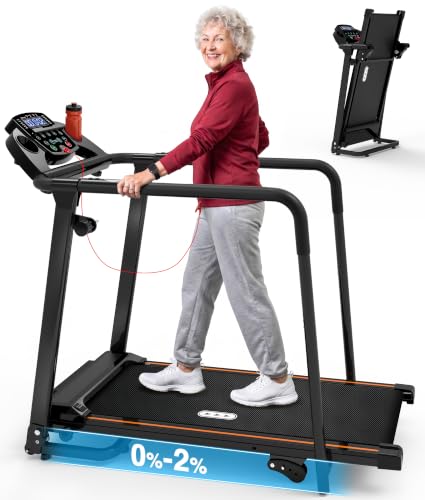
- Extended handrails for steady grip support
- Foldable frame with transport wheels
- 0%–2% incline and quiet controls
Best For: Seniors needing a compact, easy-to-store walking treadmill
Best with Extra Features
Lastforever Extra-Long Handrails

- Extra-long handrails for added stability
- 0.5 to 6 MPH for walking and recovery
- Cushioned deck with 6 shock absorbers
Best For: Seniors and rehab walkers who want steady, low-impact support
Incline Rehab Walking Pad

- Up to 40% manual incline for hill training
- Dual 51-inch handrails for taller users
- Compact foldable frame with 350 lb capacity
Best For: Users who want compact storage plus challenging incline workouts
Balance Support Recovery Treadmill

- Long handrails add stable four-point support
- Zero-impact design helps reduce knee stress
- Heart-rate sensors and 12 preset modes
Best For: Seniors and recovery users needing safe, guided walking
Senior Rehab Starter – Redliro 0.3 MPH Handrail Treadmill
For rehabilitation treadmills for home use, this Redliro model focuses on very slow, controlled walking and added support. The 0.3 MPH starting speed, dual handrails, and flat-walk option make it a practical fit for gentle recovery sessions, seniors, and anyone who wants a cautious return to movement.
Best For: Seniors, rehab users, and beginners who need a very slow start with extra stability.
Pros:
- Starts as low as 0.3 MPH for careful, low-impact walking.
- Front and side handrails add support and confidence.
- Flat surface setting is useful for joint-friendly sessions.
- Foldable frame and wheels make storage easier in smaller homes.
Cons:
- Maximum speed is limited compared with standard treadmills.
- Manual incline setup is less convenient than power incline.
- Walking belt is sized for rehab and daily walking, not longer strides.
This is a strong pick if your priority is safe, low-speed home rehab rather than performance training. The maintenance-friendly deck and built-in speed controls also make day-to-day use simpler for older adults.
Quiet Compact Rehab Walk – REDLIRO JK09F Senior Treadmill
This REDLIRO treadmill is built for rehabilitation treadmills for home use where safety, simplicity, and compact storage matter. Its extended support rails, 0% to 2% manual incline, and small footprint make it a sensible choice for daily walking in apartments or tighter living spaces.
Best For: Seniors and recovery walkers who want a compact treadmill with simple controls and extra support.
Pros:
- Extended handrails help improve balance and confidence.
- Three incline levels, including 0%, support flat recovery walking.
- Compact belt and folding design suit smaller rooms.
- Screen-off and mute features make it more comfortable to use at home.
Cons:
- Minimum speed starts at 0.5 MPH, so it is not as slow as some rehab models.
- Manual incline means adjustments are not automated.
- Running-focused features are limited compared with larger fitness treadmills.
Overall, this is a practical home walking treadmill for seniors who want extra support without taking over a room. The quick-pause function and built-in programs add convenience for simple, repeatable routines.
Incline Recovery Walker – Handrail Walking Pad for Seniors
Among rehabilitation treadmills for home use, this walking pad stands out for combining a long support rail with a gentle 5% incline. It is designed for safe daily walking, with a quiet brushless motor, remote control, and joint-friendly belt construction that keeps the focus on steady, low-impact movement.
Best For: Home recovery users who want a stable handrail treadmill with a mild incline.
Pros:
- Extra-long handrail provides steady full-body support.
- 5% incline adds challenge without requiring faster speeds.
- Brushless motor runs quietly and is designed for smooth walking.
- Remote control and clear LED display make it easy to manage workouts.
Cons:
- Speed range tops out at 4.0 MPH, so it is not suited for faster training.
- Foot-pad incline adjustment is less flexible than powered incline systems.
- More of a walking pad format than a traditional treadmill deck.
This is a smart choice if you want a stable, low-noise machine for recovery walking at home. The combination of support, incline, and simple controls makes it especially appealing for seniors and beginners.
Smart Home Trainer – NordicTrack T Series Foldable Treadmill
This NordicTrack model is a more traditional home treadmill, so it fits rehabilitation treadmills for home use best when the user is ready for broader training options. It offers cushioned walking, foldable storage, and a wide speed and incline range, but it is more fitness-focused than the senior-specific models above.
Best For: Home users who want a versatile treadmill for walking, jogging, and structured workouts.
Pros:
- KeyFlex cushioning helps reduce joint impact during walking.
- 0-10 MPH speed range supports rehab walking and later progression.
- 0-10% incline allows more varied training.
- Foldable frame and assisted lowering help save space.
Cons:
- Not as rehab-specific as handrail-focused senior treadmills.
- iFIT features and smart controls require a membership for full use.
- Much heavier and larger than compact walking-focused models.
If the goal is to start with walking and eventually progress to more intense cardio, this is the most versatile machine in the group. For pure recovery use, though, it may be more treadmill than you need.
Senior Recovery Walking Treadmill – Redliro 400 lb Foldable Rehab Model
If you’re comparing rehabilitation treadmills for home use, this Redliro model stands out for safety-first walking and recovery support. The extra-long front and side handrails, low 0.3 mph start, and gentle 0%–2% incline make it easier to walk with control, while the long belt and high weight capacity add room and stability.
Best For: Seniors or recovery users who want maximum handrail support, a roomy deck, and a very slow starting speed for steady indoor walking.
Pros:
- Long front and side handrails provide double support when stepping on, walking, and getting off.
- Starts at 0.3 mph with 0.1 mph adjustments, which is useful for rehab-style pacing.
- 400 lb capacity and 47.6″ long belt create a stable, spacious walking surface.
- Foldable design with removable handrails and transport wheels helps with storage.
Cons:
- Heavier unit at 94.3 lb, so it is not the easiest treadmill to move frequently.
- Manual incline tops out at only 2%, so it’s built more for gentle training than harder workouts.
This is a strong fit if your priority is confidence, stability, and simple walking workouts rather than speed or compact portability. It looks especially practical for daily home rehab, elder exercise, and low-impact conditioning.
Compact Handle-Bar Walking Pad – KASSADIN V800 Home Treadmill
Among rehabilitation treadmills for home use, this KASSADIN walking pad is aimed at people who want a compact machine that still feels supportive. The handle-bar setup, 3.0HP motor, mild incline, and 0.6–7.6 mph range make it flexible for walking, light jogging, and gradual daily activity in small spaces.
Best For: Home users who want a small-space treadmill with handles that can switch between walking pad and under-desk use.
Pros:
- Handle bars can be removed to convert from treadmill with handles to under-desk mode.
- 3.0HP motor and 350 lb capacity give it strong everyday performance for a compact unit.
- Built-in incline and layered cushioning add some workout variety and joint comfort.
- Quiet operation under 45dB is helpful for apartments, offices, and shared homes.
Cons:
- Walking-pad format is less rehab-focused than full senior treadmills with long safety rails.
- Best suited to small-space walking and light jogging rather than a broad rehab platform.
This model makes sense if you want a portable treadmill that doesn’t take over the room but still offers handles and incline. It is a practical choice for steady daily movement, especially when quiet operation and easy mode changes matter.
Space-Saving Senior Support Treadmill – Redliro 300 lb Foldable Model
If you need rehabilitation treadmills for home use but don’t have much floor space, this Redliro model is built around compact convenience and steady walking support. The long handrails, 0%–2% manual incline, quiet operation, and foldable frame make it a straightforward option for seniors or anyone doing light recovery exercise indoors.
Best For: Seniors and light rehab walkers who want a smaller, easier-to-store treadmill with stable handrail support.
Pros:
- Extended handrails add steady grip support during walking sessions.
- Foldable frame and transport wheels make storage and relocation easier.
- 0%–2% incline allows gentle changes in walking intensity.
- Mute control and screen-off function keep use simple and distraction-free.
Cons:
- 300 lb capacity is lower than larger senior treadmills in this category.
- 39.3″ deck length is more compact, so taller walkers may want more room.
This treadmill is a good fit if you value simplicity, quiet operation, and space-saving design over a larger deck or heavier-duty build. It works best for easy home walking routines, basic rehab movement, and consistent daily activity.
Best with Extra Features – Lastforever Extra-Long Handrails
If you’re comparing rehabilitation treadmills for home use, this Lastforever model is built around safety, low-impact walking, and simple controls. The extra-long handrails, gentle 0.5 to 6 MPH speed range, and cushioned deck make it a practical option for seniors, recovery users, and anyone who wants a steadier treadmill for daily walking at home.
Best For: Seniors, rehab users, and home walkers who want extra stability and joint-friendly cushioning.
Pros:
- Extra-long full-length handrails provide continuous support and confidence while walking.
- Quiet 2.5HP motor and 0.5 to 6 MPH range suit gentle recovery and light cardio.
- 5-layer belt, dual-layer deck, and 6 shock absorbers help reduce impact on knees, ankles, and lower back.
- LED display, handrail controls, heart-rate monitoring, and safety key keep operation simple.
Cons:
- Top speed is limited compared with full running treadmills.
- Best suited to walking and recovery rather than higher-intensity training.
- At 60.7 pounds, it is still a substantial machine to move around.
Overall, this is a strong choice if your priority is a safer, more supportive treadmill for home recovery sessions and everyday walking. The design focuses on stability and ease of use rather than advanced training features.
Incline Rehab Walking Pad – LONTEK High-Rise Handlebar
For buyers looking at rehabilitation treadmills for home use with more training variety, this LONTEK walking pad adds a steep manual incline and elevated handrails to a compact frame. It’s designed for users who want walking, light jogging, or hill-style workouts at home while still keeping storage and noise under control.
Best For: Home users who want compact storage, strong stability, and challenging incline walking.
Pros:
- Manual incline levels from 0% to 40% create a much harder hill-style workout.
- Dual 51-inch handrails and a longer belt support taller users and more upright posture.
- Quiet 3HP brushless motor runs from 0.6 to 6.2 MPH for walking, jogging, and light running.
- Reinforced frame, silicone pads, and triple shock absorption help improve steadiness and comfort.
Cons:
- The high incline can feel demanding for users who need only gentle rehab walking.
- Manual incline means you adjust levels rather than using automatic controls.
- Deck height reaches about 15 inches at max incline, so the step-up is notable.
This model stands out if you want a rehabilitation-friendly treadmill that can grow with your fitness level. It combines compact storage with unusually aggressive incline training for a home machine.
Balance Support Recovery Treadmill – KEY2FUN Long Handrail
This KEY2FUN model is aimed squarely at rehabilitation treadmills for home use, with long handrails, a low 0.6 MPH starting speed, and a zero-impact design focused on safer walking. The large LCD, preset modes, and heart-rate sensing make it approachable for seniors and recovery users who want a straightforward treadmill to use at home.
Best For: Seniors and rehab users who want balance support, simple controls, and low-impact walking.
Pros:
- Long, floor-mounted handrails provide stable four-point support for safer stepping.
- Shock absorption and a flexible deck are designed to reduce knee and ankle impact.
- Heart-rate sensors can adjust pace to help keep exercise within safer limits.
- Large LCD screen, oversized buttons, and 12 preset modes make setup easy.
Cons:
- Top speed is limited to 5 MPH, so it is not built for serious running.
- Like most recovery treadmills, it prioritizes stability over advanced workout variety.
- The carbon steel frame makes it sturdy, but not especially lightweight.
For a home treadmill centered on support and controlled walking, this KEY2FUN is a sensible pick. It focuses on balance, impact reduction, and easy monitoring rather than high-performance fitness features.
How We Picked These Rehabilitation Treadmills for Home Use
We focused on support, safety, and simplicity first. That means low starting speeds, sturdy handrails, stable frames, easy-to-read controls, and features that suit walking-based recovery rather than high-intensity running. We also looked for compact designs that fit smaller spaces without giving up essential stability.
Quick Comparison: What Matters Most
For most buyers, the biggest differences come down to support level, walking surface size, incline range, weight capacity, and how easy the treadmill is to move or store. Some models emphasize extra-long handrails and heavier-duty frames, while others prioritize portability and space-saving foldability.
Key Buying Factors for Rehabilitation Treadmills for Home Use
Support and Handrail Design
Longer handrails can help with confidence during stepping, turning, and steady pacing. If balance is a concern, prioritize models with front and side support over minimalist walking pads.
Low Speed and Smooth Start
Rehab walking usually benefits from very slow start speeds and gradual speed changes. A treadmill that begins gently is easier to control during recovery, especially for older adults or anyone rebuilding endurance.
Belt Size and Stability
A longer belt can improve comfort and reduce the feeling of crowding. Stability matters just as much: a firm deck and stable frame help the user feel secure at a slow, controlled pace.
Incline and Resistance
Light incline can add challenge, but it should be optional and easy to manage. For Rehabilitation Treadmills for Home Use, simple incline settings are usually preferable to aggressive training features.
Weight Capacity and Storage
Choose a treadmill with a capacity that leaves a healthy safety margin. If space is tight, check whether the unit folds, rolls on wheels, or has a smaller footprint that still feels supportive in use.
Who Should Buy Which Rehabilitation Treadmills for Home Use?
If you want the most confidence and support, choose a model with long handrails and a stable walking deck. If you live in a smaller apartment or need something easy to move, a compact walking pad with handles may be the better fit. If your goal is gradual fitness rebuilding at home, look for a balanced model with low-speed control, moderate incline, and simple operation. In short, match the treadmill to the user’s mobility level, available space, and recovery goals.